If you’ve ever walked past a construction site for power lines, cellular towers, or even wind energy infrastructure, you’ve likely spotted the two most common types of support structures from a distance: lattice frameworks made of angular metal beams, and smooth, cylindrical tubular steel towers. As a supplier of angle steel towers for over a decade, I’ve spent countless hours walking job sites, troubleshooting design tweaks, and explaining to engineers and project managers why one structure might be the right fit for a specific job—and how it differs from tubular steel towers. It’s not just a matter of looks, either; the gap between these two tower types comes down to material strength, cost, installation, long-term maintenance, and even environmental performance. Let’s break it down, no jargon-heavy fluff, just practical insights from someone who’s shipped hundreds of these towers across the country. Angle Steel Tower

First, let’s start with the core material and structural design, because that’s where the biggest differences begin. Angle steel towers (also called lattice towers) are built from L-shaped steel beams—standardized, rolled sections that come in a range of sizes, from 2×2 inch angles up to 8×8 inch, depending on the load they need to support. These angles are bolted, riveted, or welded together to form a rigid, open-framework structure, usually in a triangular or square grid pattern. That open design isn’t just for looks; it distributes stress across the entire framework, rather than concentrating it in a single central pole, which is how tubular steel towers work.
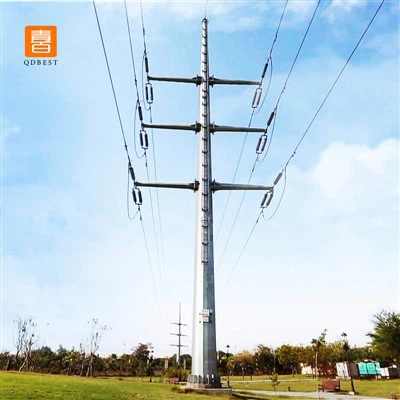
Tubular steel towers, on the other hand, are hollow, cylindrical steel pipes (or occasionally conical, wider at the base and tapering toward the top) made from seamless or welded steel plate. They’re a solid, closed structure, with no visible internal framework once erected. At first glance, that smooth, seamless look makes them seem simpler, but the design trade-offs start here. For angle steel towers, every joint is a connection point that can be reinforced—for example, adding gusset plates at the intersections of angles to prevent bending under heavy wind or ice loads. Tubular towers, by contrast, rely on the thickness of the pipe wall alone to bear weight, which means thicker pipe sections for higher loads add a lot more material to the total structure.
Next up is load capacity, a non-negotiable factor for towers that hold high-voltage power lines, cell antennas, or wind turbine components. Angle steel towers have a huge advantage here: their lattice design lets engineers optimize every part of the structure for exactly the load it will carry. For example, the lower legs of a tower (closest to the foundation) can use thicker, heavier angles to support the entire upper structure, while the upper beams can use smaller, lighter angles because they only need to carry the weight of antennas or power lines above them. That targeted design means you don’t waste steel on parts that don’t need it, and the structure can handle both vertical load (the weight of equipment) and lateral load (wind pushing against the tower) much more efficiently for medium to very high load requirements. We’ve supplied angle steel towers that support up to 500 kV power lines, plus wind turbine hubs weighing 15,000 pounds, and they hold up even in areas with 100+ mph wind gusts.
Tubular steel towers, by comparison, are less flexible in load capacity. They’re designed for uniform load distribution along their entire length, so to support a very heavy load, you need a much thicker pipe wall, or a larger diameter pipe. That adds more material, which increases the total weight and cost. Some tubular towers top out at supporting 220 kV power lines or smaller wind turbines, though for very heavy loads, they can become prohibitively expensive. I’ve had clients come to me after trying a tubular tower for a 345 kV line project, only to find the pipe was so thick and heavy that the foundation costs doubled—something angle steel towers avoid because their open design spreads weight more evenly.
Then there’s installation, which is a big factor for remote job sites, mountainous terrain, or areas with tight space around the tower footprint. Angle steel towers are modular: we ship each section of the lattice (the legs, the cross-arms, the top section) as prefabricated parts, which are small enough to fit on standard flatbed trucks, even on winding mountain roads or narrow construction access points. On-site crews assemble the pieces, bolting them together at the joints, which means you don’t need a super heavy-lift crane for small or medium towers—often a 50-ton crane is enough for a 200-foot angle steel tower. Plus, modular design means if a part gets damaged during transport or on-site, it’s easy to replace just that one piece, not the whole tower.
Tubular steel towers, by contrast, are much larger and heavier as a single piece (or two, for smaller towers). Even a 200-foot tubular tower is a single unit (or split into two halves for transport) that weighs 100,000 pounds or more. That means you need a super heavy-lift crane (often 150 tons or larger) to erect it, and the transport requires specialized, wide-load permits, which add time and cost. For remote sites where access is limited—like a power line running through a national forest, or a wind farm in a rural mountain valley—angle steel towers are far easier to move and assemble. I once worked on a project in the Rockies where the only access road was 12 feet wide; tubular towers couldn’t fit, so we shipped angle steel sections via flatbed, and crews assembled them on-site in three days, with no extra permit delays for oversized loads.
Maintenance and longevity are another area where the two tower types differ, and it’s a detail that’s easy to overlook when you’re just choosing based on upfront cost. Angle steel towers, with their open framework, are easier to inspect and maintain. You can climb the lattice beams to check for rust, tighten loose bolts, or replace a damaged angle without having to use a lift or rope access. Because the angles are exposed, corrosion (rust) is easy to spot early—we always hot-dip galvanize our angle steel towers, which gives them a protective zinc coating that lasts 50+ years, but even if the coating gets scratched, you can touch up damaged areas on individual angles, not the whole tower. The open design also lets wind pass through the lattice, reducing wind load on the structure over time, which means less stress on the metal joints.
Tubular steel towers, on the other hand, have a solid, enclosed shape that traps moisture inside the pipe, especially at the base where the tower meets the foundation. That trapped moisture creates a perfect environment for internal corrosion, which you can’t see until it’s advanced enough to weaken the pipe wall. Inspecting a tubular tower requires rope access teams to climb the exterior, and to check internal corrosion, you have to drill test holes into the pipe wall—something that’s not easy or cheap. Maintenance also means you can’t just replace a single section; if a tubular tower develops a corroded spot, you often have to cut out a segment of the pipe and weld a new piece in, which is a more complex and costly repair. That’s why many utility companies I work with prefer angle steel towers for long-term projects, where maintenance costs over 30 years add up to a big difference.
Now, let’s talk about cost, which is the first question almost every client asks. Upfront, tubular steel towers often seem cheaper, especially for smaller, lighter loads. A 100-foot tubular tower might cost 15% less than an equivalent angle steel tower, because the material is a single pipe and the manufacturing process is simpler. But that’s where the hidden costs come in, as I mentioned earlier: transport, foundation, and maintenance. For a 200-foot tower that supports a 345 kV power line, the total cost often ends up 25-30% higher for a tubular tower than an angle steel one. The thicker pipe needed for heavy loads increases material cost, the oversized transport permits and heavy crane add tens of thousands in extra fees, and the higher maintenance costs over the tower’s lifespan can add another 10-15% over 30 years. Angle steel towers, because of their modular design and optimized material use, have lower total cost of ownership for most projects, especially medium to large scale.
There are also niche use cases where tubular towers make sense, even with those trade-offs. For areas with strict visual regulations—like a suburban area, a historic district, or a coastal resort—some clients choose tubular towers because their smooth, cylindrical shape is less obtrusive than the open lattice of angle steel towers. Tubular towers can be painted to match the surrounding landscape, making them less visible, which is a big plus for projects in residential areas. They’re also better for areas with very low wind speeds, where the open lattice of angle steel towers might create minor turbulence, though that’s a specialized use case, not the most common scenario.
As someone who’s been in the angle steel tower supply business for years, I’ve seen clients make the wrong choice by only looking at upfront cost, or assuming tubular towers are better because they look simpler. The key is matching the tower type to the project’s specific needs: if you’re working on a remote mountain power line, or a high-load wind farm, angle steel towers will save you money on transport, installation, and maintenance over time. If you’re in a suburban area where visual impact is top priority, and the load is light, a tubular tower might make sense. But in most cases, angle steel towers are the more practical, cost-effective choice for large-scale infrastructure projects.
At the end of the day, every project is different, and there’s no one-size-fits-all answer. But understanding the core differences in design, load capacity, installation, and maintenance helps you make the right choice for your timeline and budget. If you’re planning a project that involves power lines, cell towers, wind energy, or any other infrastructure that needs a support structure, we’ve got the experience to supply angle steel towers tailored to your exact needs. We work with utility companies, construction firms, and renewable energy developers across the country, and we can help you design a tower that fits your site, your load requirements, and your budget.
If you’re ready to talk through your project, we’re here to help with every step, from initial design consultations to on-time delivery and support for installation.
Angle Steel Tower References
- American Iron and Steel Institute (AISI). (2021). Steel Transmission Tower Design Manual.
- International Electrotechnical Commission (IEC). (2019). Structural Design Requirements for Overhead Line Towers.
- National Association of Structural Steel Suppliers (NASSS). (2022). Lattice vs. Tubular Steel Tower Cost and Performance Comparison.
- IEEE Power & Energy Society. (2020). Maintenance Best Practices for Electrical Transmission Infrastructure.
Qingdao BEST Steel Structure Co., Ltd.
Qingdao BEST Steel Structure Co., Ltd. is one of the most professional angle steel tower manufacturers and suppliers in China. We warmly welcome you to buy customized angle steel tower made in China here from our factory. If you have any enquiry about OEM service, please feel free to email us.
Address: Jiaobei Industrial Park, Qingdao, China
E-mail: salesmanager@qdbsstower.com
WebSite: https://www.qdbsstower.com/
